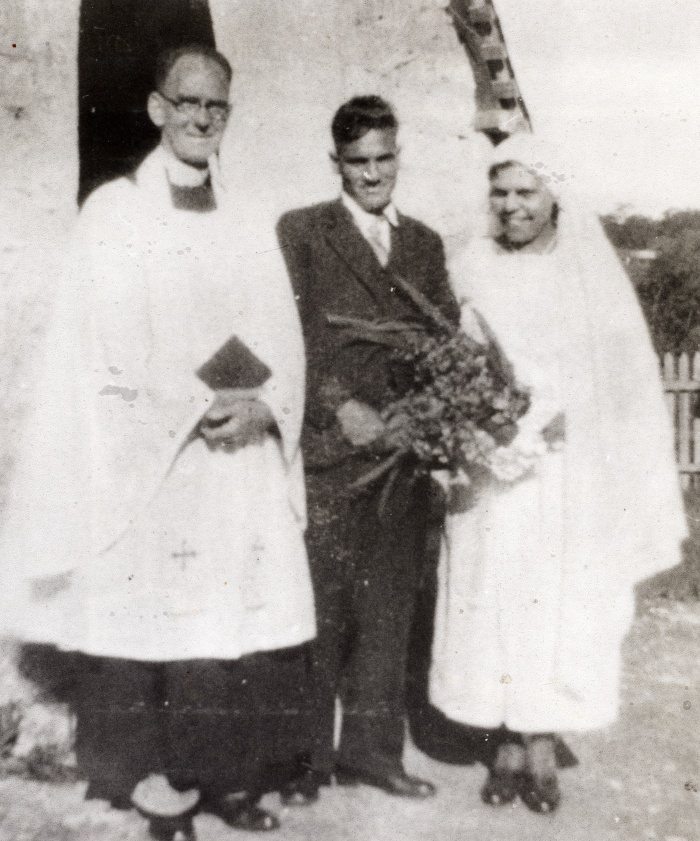
This story is based on an interview with Jessie Coyne in 1992.
It is by sharing these stories and images from our collection, we hope to initiate meaningful and respectful relationships. By elevating Aboriginal voices, we hope to inspire a shared vision of unity, respect, and self-determination for all. By acknowledging the truths of our past, we hope to heal together.
Aboriginal and Torres Strait Islander viewers are advised that this post may contain images of deceased persons. Readers are warned that this post references Moore River Settlement and events that can hold trauma.
My name is Jessie Coyne, I was born in Carnarvon on the 10th of January 1918.
I was very small when I got taken away from my mother.
I don’t remember the year that I left Carnarvon and the boat, I think, was the MV Kangaroo or Kalinda. From there, I just sort of went onto the boat as if I was going to fairyland.
They took me from Middalya Station, and these other two children, Bill and Dora, were already in the police car.
I had no contact with my family when I went to Moore River.
I got real bitter at times, because nobody came to see me and there were lots of other little children there too, you know, kiddies, and they had nobody to come and see them. I felt absolutely neglected.
After a while, another little girl came and it was Dora’s young sister, Jean, but she died in Moore River.
She got double pneumonia, and if you wanted medical attention, you had to go to Moora, and that was a drive up and back. The doctor only came if you was really sick, but she’d already developed too much and they couldn’t save her.
We also had a lot of eye trouble, because the water wasn’t so good, and we got a lot of flus. What else did we get? A lot of stomach trouble.
It was just bread and fat in the morning, and porridge, then you had this watery soup. You never ever saw any meat. The bigger girls got that if there was any, which was very little.
We were hungry often, in the wintertime mostly I felt it because I think you ate more at wintertime.
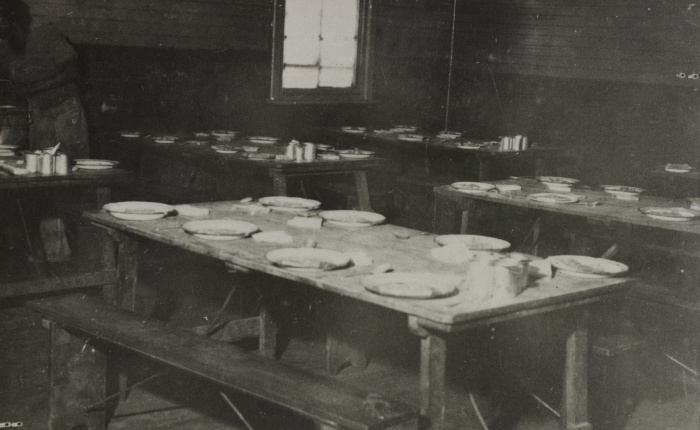
Dining room interior, Moore River Settlement, ca. 1949.
In school, you only went up to fourth standard, nothing more. When you got to fourth standard, they said, “There’s nothing more we can teach you.”
But I liked a lot of reading. I used to like The People’s Travels, I found that very interesting. And a lot of things I picked up was the National Geographic magazines.
From there, most of them never had any education, and if they learned anything, well, they had to pick it up all themselves.
I had a few duties at Moore River. I worked in the hospital for a while, and I worked down the superintendent’s place, whenever they needed somebody. Sometimes I’d help out some of the other girls, I used to hand-wash everything, all the other kiddies’ clothing and the boys that sort of thing.
I had a go at sewing. Most of the clothes there were going up to the Forrest River Mission, and I don’t know if a lot went around to Kalgoorlie and all them other places. Other than that, well, you had no materials, no money to spend on yourself and you never had any warm clothes for the winters.
It was only twice a week that you got a change of clothing, and sometimes we’d be silly enough to go and play in mud. You’d have to wait until the mud dried off and then brush it off.
We used to play marbles, and somebody brought in an emu of all things, and he more or less grew up with the kids. The emu had a long neck, and he’d swallow the marbles you got, and we had no money to buy any more.
He wouldn’t go out of the compound anyhow, so we’d follow him around with a couple of sticks and go and look in his droppings and get all our marbles back again.
I met my husband, oh, must’ve been early ’36. We got married on the 2nd of August 1937. Fifty-five years we’ve been married.
We were supposed to have a double wedding at the little church. But the order came around to say that we had to get this ship to go up to Port Hedland, so they took us down to Gingin and got us married there, and we stayed in Gingin until the train came back down.
I forget what year we came down to Albany. After Lester was born in 1947. We were married 10 years before we had any children, and Lester is the eldest boy.
Just earlier this year, one of the kids, the youngest one, he said, “Mum, I seen you and Dad’s photo in the photo display of all from Moore River.” I said, “You didn’t.”
So we got into the car and we went down to the Aboriginal hall there, and it was, not only our photo but others too that got married up there.
We ordered a copy there, and they sent us back the photo. We were lucky to get it. And of course, all the family’s now got one each.
They said, “We’re going to have one each, and that’s that!” So, if any more gets lost, well, we can always get it from the two girls and four boys.
Listen to the full interview with Jessie as part of the State Library's Oral History Collection.